AquaJoy Flasher System — Engineering White Paper
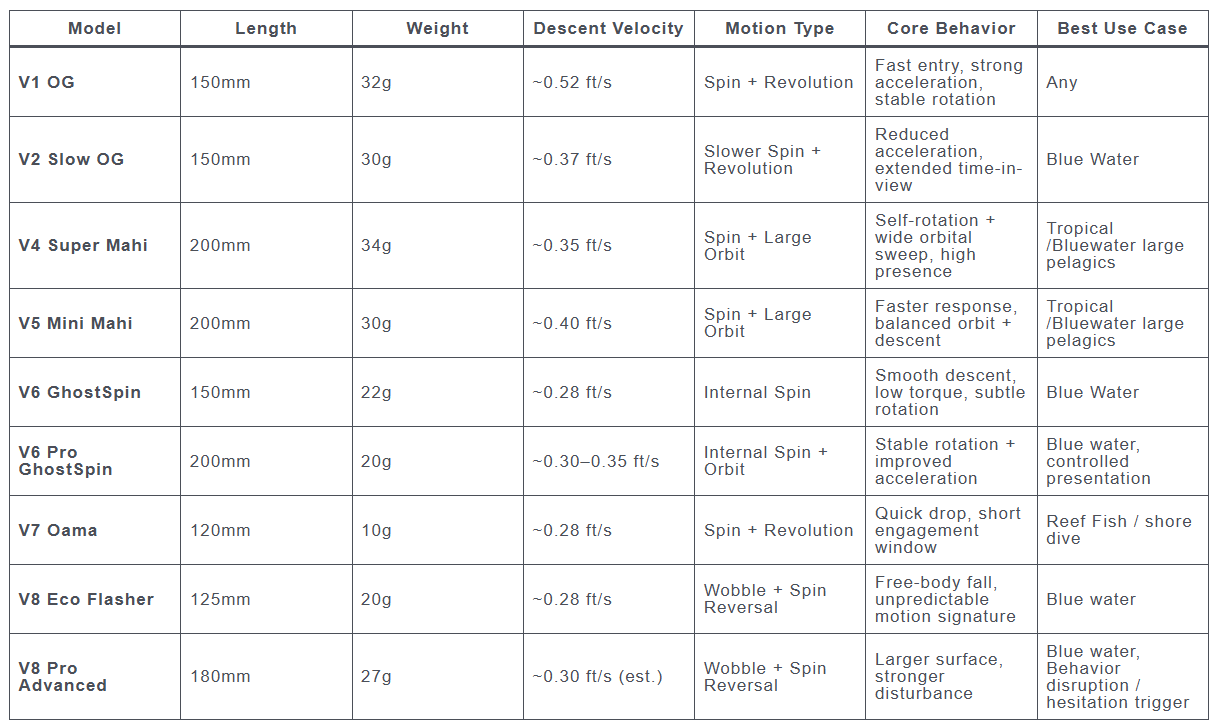
**All AquaJoy Flashers are passive systems with no moving parts.
***Sink speed variable by salinity and current variations. V1 tested in SoCal Reef. V4, V5 Data base on test done in Puerto Rico Blue water
Abstract
AquaJoy flashers are passive hydrodynamic devices engineered to control descent time, motion behavior, and visual signaling in open water without mechanical or electronic components. This document outlines the governing principles behind geometry-driven underwater motion and controlled time-in-view.
Core Engineering Principle
Attraction is governed by time-in-view and spatial light distribution, not peak brightness. The system replaces material accumulation and surface coatings with geometry-driven motion control.
Descent Control
Sink rate is treated as a control variable. Slower, repeatable descent increases tracking, hesitation, and commitment behaviors in pelagic species.
Geometry & Motion
The flasher behaves as a passive rotating reflector. Controlled geometric imbalance converts linear descent into coupled rotational motion. As the body rotates, planar facets sequentially redirect ambient light across multiple angles, producing a spatially distributed and time-extended visual signal rather than a single-point flash.
Multi-faceted geometry is optimized for cross-sectional projection rather than facet count alone. Extended body length increases exposed reflective surface over time during descent.
Light Interaction
Reflection is emergent. Multi-planar facets redirect ambient light dynamically as the body moves, producing non-repeating visual signals.
Material Constraint
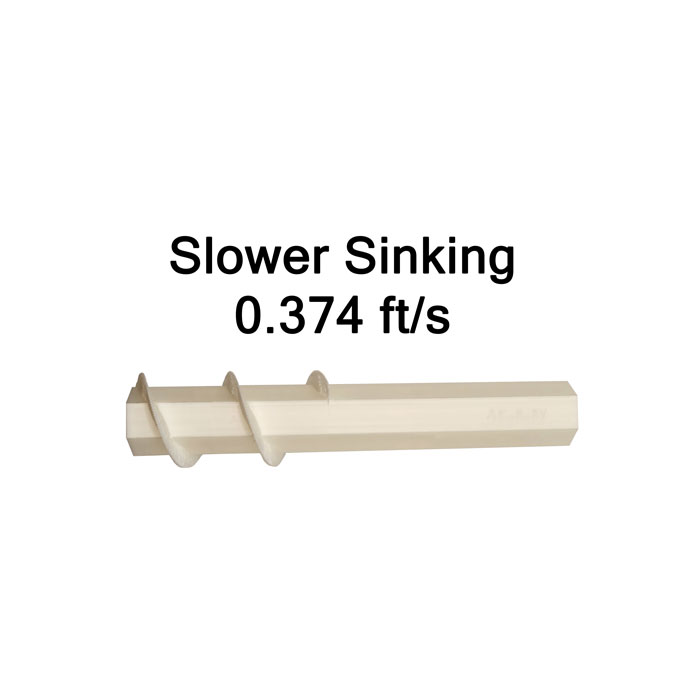
Silk PLA based bioplastics are used as a design boundary to reduce long-term persistence compared to PVC or ABS while maintaining functional rigidity. It also composites provide inherent pearlescent reflectivity. Optical performance is achieved through material selection and geometry, not added components. This eliminates secondary materials while preserving reflective continuity under rotation.
Drag Modulation & Apparent Size Amplification
Optional drag elements introduce controlled hydrodynamic drag. Visual amplification is achieved through fluid interaction, not mechanical complexity. Apparent visual footprint is increased without altering core mass distribution or stability.
Engineering OutcomeYour Attractive Heading
Time-in-view and effective reflective area are increased without increasing complexity, introducing mechanical risk, or relying on disposable components.
| Feature | Traditional PVC | Throw Flasher ABS | AquaJoy Flasher (PLA SILK) |
|---|---|---|---|
| Material | PVC | ABS | PLA Silk (eco-conscious, pearlescent) |
| Density | ~1.38 g/cm³ | ~1.04 g/cm³ | ~1.20–1.25 g/cm³ |
| Sink Rate | ~0.4 ft/s | ~0.22 ft/s | Controlled: ~0.28 – 0.50 ft/s |
| Sink Control | Uncontrolled | Fixed | Tunable (geometry+buoyancy) |
| Acceleration | Passive drop | None | Controlled descent modulation |
| Motion | Minimal / straight drop | Minimal | Spin / rotation / wobble / hybrid |
| Reflection Type | Tape-based | Electroplated coating | Geometry + material reflection |
| Reflective Area | Surface tape | ~120 × 7.5 mm | Full-body distributed reflection |
| Reflection (Horizontal) | Partial / inconsistent | ~120° | 360° |
| Reflection (Vertical) | Limited | ~15° | 360° |
| Blind Spots | Present | >300° | 0° |
| Visibility Time | Short-Medium | Long | Controlled Duration |
| Fish Behavior | Pass-By/Quick Reaction | Limited to reflection zone | Hesitation / circling / approach |
| Recovery | Often Lost | Recoverable | Recoverable |
| Design Approach | Reflection | Slow Descent + Surface reflection + geometry | Behavior engineering system |
| Patent | None | None | Multi-design patents pending |